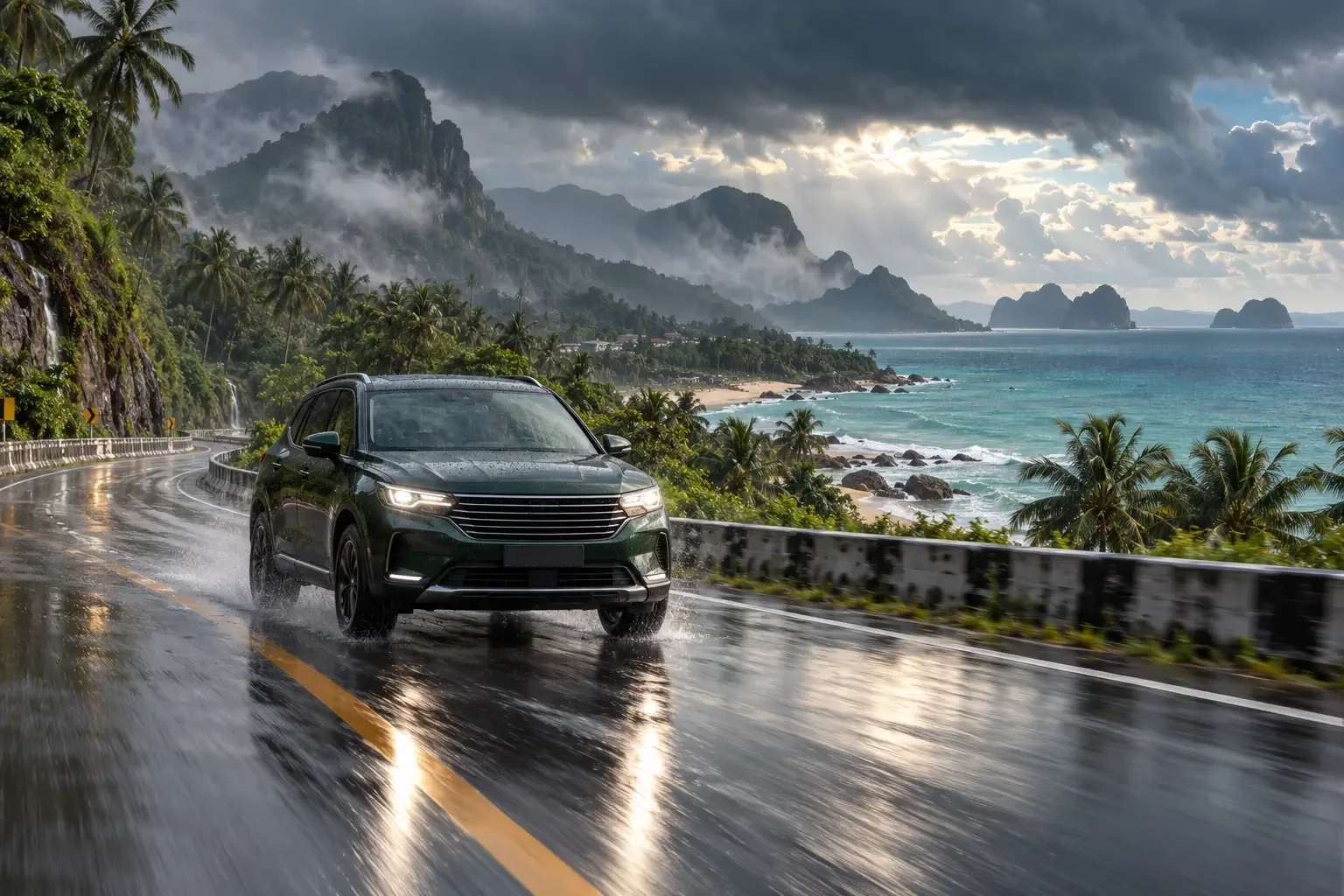
Thailand's rainy season is not one national switch. Conditions differ by region, coast, altitude and week, and a road can be dry while the next province receives a severe downpour. A safe self-drive plan therefore uses local conditions close to departure and keeps enough flexibility to delay, shorten or reroute a day.
Plan region by region
Check the forecast for the exact route, not only the destination city. Mountain sections, low coastal roads and urban underpasses react differently to the same rain. Ask accommodation staff about the final access road; a driveway or small bridge may be the weakest part of an otherwise normal journey.
For long transfers, identify substantial towns, fuel stops and possible safe waiting places. Download navigation and contact details before leaving reliable coverage.
Inspect the wet-weather basics at pickup
Make sure the tyres show visible tread and no obvious damage. Test wipers, washers, headlights, demisting and air-conditioning. Clean the windscreen inside and outside. Ask how to report a warning light, puncture or water-related problem.
Do not accept a vehicle with a serious visibility or tyre concern because rain has not started yet. The equipment is most valuable precisely when conditions change unexpectedly.
Use a three-level rain decision
Light rain
Reduce speed, increase distance and make smooth inputs. The first rain after a dry period can lift oil and dust, so grip may fall before water looks deep.
Heavy rain with useful visibility
Slow further, use appropriate lights, avoid overtaking and keep away from spray beside large vehicles. If traffic forms a calm queue, preserve the gap rather than searching for a faster lane.
Visibility no longer supports driving
Leave the road at a safe location such as a staffed service area. Do not stop beneath trees, on a bridge, in a low underpass or beside fast traffic. Waiting is an active safety decision, not a failure to complete the route.
Never guess the depth of floodwater
Standing water hides drains, damaged pavement and currents. If depth, road edge or exit cannot be seen, do not enter. A pickup or bus crossing does not prove that a rental car can follow. Turn around or wait for verified local guidance.
If water begins rising around a stopped car, prioritise people and follow emergency instructions. Do not attempt to restart a stalled engine in floodwater; contact assistance.
Mountain roads add falling material and braking
Rain can move leaves, soil and stones onto bends and reduce the view around slopes. Drive in daylight when possible, finish braking before the turn and use an appropriate lower gear or vehicle mode on descents. Leave more space from the uphill edge and never stop below an unstable slope.
If officials close a road, treat the closure as final. Navigation may continue to suggest it because map data has not updated.
After the cloud passes
Risk continues with glare, spray and wet road markings. Test brakes gently after shallow water and listen for changes. At the next safe stop, walk around the car and look at tyres and lower bodywork. Report any impact or warning.
Carry a compact rain kit
- Charged phone, power cable and offline maps.
- Dry cloth for glass and mirrors.
- Water, light food and a rain layer.
- Waterproof document pouch.
- Rental, accommodation and emergency contacts.
- Enough time to wait without missing a critical deadline.
Protect flights and fixed appointments
Do not place a mountain or long coastal drive immediately before a flight. Build a generous buffer or stay nearer the airport the previous night. When weather deteriorates, notify the rental provider and accommodation early; written communication creates more options than a late arrival with no explanation.
Choose a car that the driver can position confidently and inspect its wet-weather equipment when comparing the Thailand rental options. The most important rainy-season feature is not vehicle size. It is a plan that allows the driver to stop.